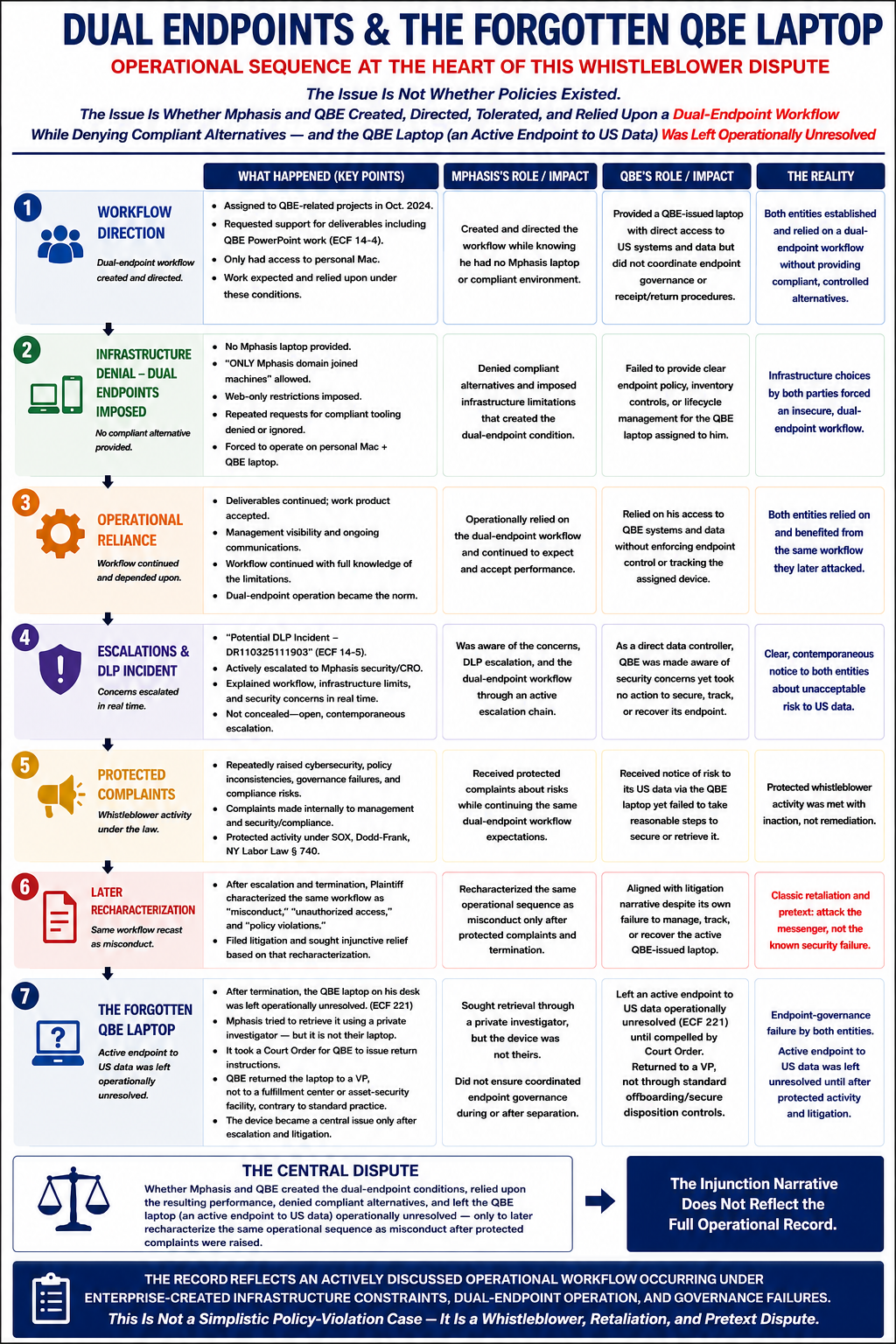
This operational record concerns whether Mphasis and QBE created, directed, tolerated, and relied upon a dual-endpoint workflow while simultaneously denying compliant alternatives, and whether the resulting workflow was later recharacterized after protected complaints, security escalation, and termination.
The central issue is not whether written policies existed. The central issue is whether enterprise-created infrastructure constraints, operational expectations, and ongoing management visibility resulted in a normalized dual-endpoint operating model involving both a personal Mac workstation and a QBE-issued laptop.
Mphasis Infrastructure Constraints
No Mphasis-issued laptop was provided during the relevant operational period. Web-only restrictions and infrastructure limitations constrained available workflow options. Repeated requests for compliant tooling, endpoint alignment, and operational clarification were denied, deferred, or left unresolved while work expectations continued.
QBE Project Workflow and Operational Reliance
QBE-related assignments and deliverables continued throughout the engagement, including operational work involving PowerPoint deliverables, governance discussions, and cross-platform endpoint activity. Management maintained visibility into communications, deliverables, and ongoing workflow conditions.
The operational workflow became normalized through continued reliance on the resulting dual-endpoint model, including the use of both personal-device access and QBE-issued endpoint access.
Dual Endpoint Governance and DLP Escalation
Potential DLP concerns, cybersecurity risks, infrastructure limitations, and endpoint governance issues were raised internally and contemporaneously. The workflow conditions, endpoint exposure concerns, and governance implications were openly discussed during the operational period.
Protected complaints included concerns involving:
- endpoint governance failures
- dual-endpoint operational exposure
- infrastructure limitations
- security escalation handling
- enterprise workflow controls
- compliance and governance risk
Operational Recharacterization
After escalation and termination, the same operational workflow that had been created, relied upon, tolerated, and operationally normalized was later characterized as misconduct and policy violation activity.
The dispute therefore concerns whether the operational sequence reflects:
- enterprise-created workflow conditions
- denial of compliant operational alternatives
- continued reliance on resulting deliverables
- protected complaints and escalation activity
- subsequent recharacterization after termination
The Forgotten QBE Laptop
The QBE-issued laptop remained operationally unresolved after termination and later became central to the broader governance, endpoint-management, and litigation narrative.
The dispute concerns whether operationally required conduct created under enterprise-controlled conditions was later retroactively reframed as misconduct after protected escalation activity.
The operational record reflects an actively discussed workflow occurring under enterprise-created infrastructure constraints, dual-endpoint operation, and unresolved governance conditions.
Questions Raised By The Operational Record
The operational record raises governance, endpoint-management, and access-control questions that extend beyond the individual dispute:
Endpoint Governance
- Is endpoint accountability a fundamental information-security principle?
- Is asset custody a basic governance responsibility?
- Is timely recovery of enterprise endpoints an expected security control?
- Who was responsible for return instructions concerning the QBE-issued laptop?
- Why did responsibility for retrieval remain unresolved for months?
- Why was court intervention ultimately required before return instructions were provided?
Dual-Endpoint Operations
- What security review was performed before requiring work to continue without a Mphasis-issued laptop?
- How were contractors expected to access Mphasis systems when a Mphasis-issued endpoint was not provided?
- Were dual-endpoint workflows known to management, IT, and security personnel?
- Were employees and contractors expected to alternate between client-managed and employer-managed environments to perform assigned work?
- What controls existed to prevent cross-environment data exposure between client and employer systems?
- Were those controls reviewed after concerns were raised?
Access Controls and VPN Segmentation
- Were contractors permitted to access Mphasis resources from client-issued devices?
- If so, under what governance framework?
- Were contractors expected to alternate VPN connectivity between client-managed and employer-managed environments in order to perform assigned work?
- If so, was that workflow reviewed and approved by information-security personnel?
- What network segmentation controls existed between QBE-managed and Mphasis-managed environments?
- What controls existed to prevent cross-domain exposure when moving between client and employer environments?
- Were security teams aware that operational work required movement between multiple enterprise environments?
- Were those operational conditions documented and approved?
- How were access-control risks evaluated when work expectations continued under those conditions?
Security Escalation
- Were cybersecurity concerns regarding the dual-endpoint workflow raised during the engagement?
- Were cybersecurity concerns regarding dual-endpoint operations reported to Mphasis cybersecurity personnel in October 2024?
- When were those concerns first reported?
- How were those concerns investigated?
- What remediation steps, if any, were taken?
- Were operational expectations modified after those concerns were reported?
- If not, why not?
- If concerns were escalated, what actions were taken in response?
Governance and Operational Reality
- How should organizations reconcile formal security policies with operational realities when compliant infrastructure is denied?
- What governance obligations exist when work is expected to continue despite known infrastructure limitations?
- Can an organization rely on a workflow operationally while simultaneously characterizing that same workflow as improper after the fact?
- How should accountability be allocated when infrastructure constraints are created by the enterprise itself?
The purpose of this page is to preserve the operational sequence reflected in the
record and to identify governance questions raised by that sequence.
Can the conduct be fairly evaluated without considering the operational environment that produced it?
Readers may draw their own conclusions from the underlying record.
Independent Public Interest and Whistleblower Notice
QBE.global is an independent, non-commercial public-interest archive operated by Albert Rojas. This website is not affiliated with, sponsored by, endorsed by, or authorized by QBE Insurance Group Limited, Mphasis Corporation, or any related entity.
References to QBE, Mphasis, company names, trademarks, personnel, systems, and business operations are used solely for identification, commentary, analysis, criticism, public-record review, litigation-related discussion, and matters of public concern.
This page reflects commentary, analysis, opinion, governance questions, cybersecurity discussion, compliance review, and protected whistleblower activity. Readers are encouraged to review source materials and draw their own conclusions.